
Download Ebook Judgment at Tokyo: The Japanese War Crimes Trials
When you really need it as your source, you could locate it currently as well as right here, by locating the link, you can see it as well as begin to get it by conserving in your personal computer system device or move it to various other tool. By getting the link, you will obtain that the soft documents of Judgment At Tokyo: The Japanese War Crimes Trials is actually recommended to be one part of your pastimes. It's clear as well as wonderful enough to see you feel so fantastic to get the book to read.
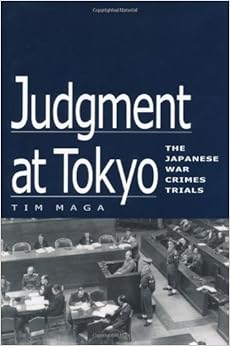
Judgment at Tokyo: The Japanese War Crimes Trials

Download Ebook Judgment at Tokyo: The Japanese War Crimes Trials
Feel lightheaded of your due date work? It appears that you require enhancement sources as well as ideas, do not you? Do you like analysis? What sort of analysis products you may probably enjoy to do? We will certainly reveal you Judgment At Tokyo: The Japanese War Crimes Trials as one of the recommended publications that will certainly remain in this place. As recognize, this internet is very popular with all fantastic publications in soft documents version. When you have suggestions making handle this book, it needs to be quickly done.
Well, currently allow's see exactly how the book will be presented for you. Judgment At Tokyo: The Japanese War Crimes Trials is the one that could influence you to have better time to kick back. So, what you get in the spare time is not just relaxing but likewise more understanding. Expertise as well as experience are extremely worthwhile and also they will certainly be timeless. The visibility of this book could support you to have that ageless worth. Really priceless as well as important are just what you could additionally get from reading this publication.
While the other people in the establishment, they are not sure to discover this Judgment At Tokyo: The Japanese War Crimes Trials straight. It might need even more times to go shop by shop. This is why we mean you this website. We will offer the most effective means and also referral to get the book Judgment At Tokyo: The Japanese War Crimes Trials Even this is soft documents book, it will be convenience to bring Judgment At Tokyo: The Japanese War Crimes Trials wherever or save in the house. The distinction is that you might not require move guide Judgment At Tokyo: The Japanese War Crimes Trials location to location. You may require only copy to the various other gadgets.
If puzzled on how you can get the book, you might not need to get perplexed anymore. This internet site is served for you in order to help everything to find guide. Due to the fact that we have finished publications from globe writers from numerous countries, you need to get guide will certainly be so simple here. When this Judgment At Tokyo: The Japanese War Crimes Trials tends to be the book that you need a lot, you can discover it in the link download. So, it's very easy then just how you get this publication without investing sometimes to browse and locate, experimentation in the book store.
From Booklist
Between 1946 and 1948, a large segment of Japan's wartime military and civilian leadership was tried for war crimes. The trials never received the publicity of the Nuremberg trials. Although the Nuremberg trials have generally been immune from reproach by historians, the Tokyo trials have frequently been criticized as "racist," "hypocritical," or an example of "victor's justice." The fact that Emperor Hirohito was granted de facto immunity enhanced the impression of unfairness. Maga, a professor of American heritage at Bradley University, has previously written extensively on U.S.-Japanese relations. He convincingly asserts that the Tokyo trials must be viewed separately from Nuremberg, since there were no accusations at Tokyo of a calculated plot of genocide. Given the limitations imposed by that fact, Maga believes that the trials were warranted and generally conducted fairly. Furthermore, the Tokyo trials set important precedents in establishing what factors constitute war crimes and how they can be effectively prosecuted. This is a provocative and timely work. Jay FreemanCopyright © American Library Association. All rights reserved
Read more
Review
"A useful reminder of how little we still know of the Tokyo trials and how much we should." -- Journal of American History"Illuminates the trials for what they were-cumbersome." -- Asahi Shimbun"The author sees the Tokyo trials as effective tools of justice and worries that the trials were downplayed." -- WTBF“Covers the gulf between the literature associated with the post-WWII trials of Nazi war criminals and their Japanese counterparts.” -- American Society of International Law Newsletter“He has done us all a service, reopening the question of what really happened in those terrible years, and why.” -- Japan Quarterly“The book’s length and style serve as a general introduction to this aspect of the war with Japan.” -- Journal of Military History
Read more
See all Editorial Reviews
Product details
Hardcover: 240 pages
Publisher: University Press of Kentucky; First Edition edition (January 11, 2001)
Language: English
ISBN-10: 0813121779
ISBN-13: 978-0813121772
Product Dimensions:
6.2 x 1 x 9.5 inches
Shipping Weight: 11.2 ounces
Average Customer Review:
3.5 out of 5 stars
8 customer reviews
Amazon Best Sellers Rank:
#1,070,291 in Books (See Top 100 in Books)
Not an in depth look. Kind of skims the surface.
America in the form of MacArthur let HIrohito think the former was a dimwit who actually believed the Japanese could not go on if Hirohito abdicated or suicided and that was why Hirohito was allowed to remain in position.Extended family members were offering up themselves as alternatives to the current emperor as well as badmouthing Hirohito to the Americans.They were all involved. They were SEEN in Asia doing the dirty work, giving the orders, overseeing the atrocities.So they were stripped of their titles and were not allowed to openly own their wealth. Hirohito's direct line was allowed all the excessive trappings of internationally recognized royalty.The last war was a big family business.No matter how generous Akihito may have been over the years, his cousins have had a long time to envy the ones who got away with it.And frankly, the general population ie the majority of Japanese in Japan are no longer in a position where they have to pretend that the imperial bloodline is necessary for their own survival. Just as with most first world status governments, the govt serves the people and is responsible to the people. The people are NOT the servants of the monarch anymore and good luck trying to change things back to before MacArthur HANDLED the bloodline.
Tim Maga has done it again. The nation's premier scholar of US-East Asian relations has joined John Dower and Herbert Bix in considering postwar Japan. This book rises immediately to the top rank of studies of its specific subject and of the post-World War II period in general. The book is admittedly not an encylopedic review of the trials, although those who are searching for descriptions of the grotesque actions of Japanese war criminals will not be disappointed here. Rather the book's strength is in its ability to show how the trials played a crucial role in other important developments of the time. Dr. Maga's approach thus sheds new light on MacArthur's occupation government and its relationship with the State Department, the bifurcated view of war criminals in Japan itself as both villains and heros, and the developing Cold War in general and the Korean War in particular. The final chapter adds provocative insights into the legacy of the Japanese war crimes trials in light of the ongoing debate of how to deal with war crimes in the present day. Dr. Maga's research is impeccable and includes several heretofore unused sources. Out of this he has fashioned a book which must be considered by anyone plowing this field in the future. Expect to see this book receiving major awards later this year.
I read the other reviewers...I usually do that with historical books because of the importance of those who may have a different perspective than someone like me who is coming into this particular arena of history with no background. I have read a lot about the Nuremberg Trials, much about German aggression, and very little about Japan. Growing up in the San Francisco Bay Area, with my grandfather a commander in the Navy, I grew up with a sense of pride, and also wanting to know more about the time in which he served, and shortly after when my father also served (Korea). But I also got snippets of information from other readings concerning the very unfair treatment of the Japanese in the U.S. when their homes were raided and they were placed in concentration camps. So of course, I was curious when I came across this small book.For historians and social study teachers, this might be a good book to read for background. Some people write and make history come alive again. Others write history, and most people would put this book back down because it is so dry, and is written with an evident bias that is not always backed up with support. I guess I would have to read the actual transcripts of the trial because this particular one apparently did not gain the attention of the world. Those who came in close contact with Japanese atrocities such as China, Australia, and most importantly, the Phillipines definitely had a different viewpoint then most of the Americans involved in the Trials. MacArthur and the main judge, Keenan, evidently controlled quite a bit of the trials...who came to trial, who did not, who was punished, what the punishments were. I had a problem in that mentions were made of the atrocities, but unlike the very well-known Final Solution, Japanese atrocities were not as much fodder for the newspapers. Heaven only knows why.All countries have time periods in their histories for which they should feel shame, including the U.S. Wisdom is when those countries recognize and address those problems, and many of the Japanese did incredible things such as one sobbing man turning in his own son for almost certain capital punishment for killing an entire Burmese town. If only more of us would show the courage that older man did in doing this, our world would be a better place.I am going to read more on this area/trials, because Maga whetted my appetite, but didn't satisfy it. Whether our side was fair in their judgements, whether the Emperor should have paid a higher price (I think MacARthur handled this one right)...is probably up to those who read these books to make that judgement. It is a part of our world history, and Japan has certainly come a long way from their militarism of that time. Nationalism and militarism is scary in any form, no matter which country is involved. We've seen way too many nationalistic-caused atrocities in AFrica, Serbia, Germany, etc. I can't help think but of some words that said "Judge not, lest ye be judge..."Karen Sadler,Science Education,University of Pittsburgh
Maga does an excellent job of weeding through post-war propaganda and revisionist history to reveal a trial which was much more fair and effective than most scholars have argued. Maga carefully documents the Japanese attempts to turn world opinion against the trials and, through various machinations, detract from the criminal acts of those on trial. He also reveals the degree to which American politics, now focused on the Soviet threat and anxious to shore up Japanese support against Communism,, influenced the trial and brought about lenient sentences for war criminals, and in some cases (Emperor Hirohito, especially), no trial or punishment at all. An excellent read!
Judgment at Tokyo: The Japanese War Crimes Trials PDF
Judgment at Tokyo: The Japanese War Crimes Trials EPub
Judgment at Tokyo: The Japanese War Crimes Trials Doc
Judgment at Tokyo: The Japanese War Crimes Trials iBooks
Judgment at Tokyo: The Japanese War Crimes Trials rtf
Judgment at Tokyo: The Japanese War Crimes Trials Mobipocket
Judgment at Tokyo: The Japanese War Crimes Trials Kindle

Tidak ada komentar:
Posting Komentar