
Free PDF The Poisoner's Handbook: Murder and the Birth of Forensic Medicine in Jazz Age New York, by Deborah Blum
This is not around just how much this publication The Poisoner's Handbook: Murder And The Birth Of Forensic Medicine In Jazz Age New York, By Deborah Blum expenses; it is not additionally concerning just what sort of e-book you truly love to read. It has to do with just what you could take and receive from reading this The Poisoner's Handbook: Murder And The Birth Of Forensic Medicine In Jazz Age New York, By Deborah Blum You can like to choose other book; however, it does not matter if you try to make this book The Poisoner's Handbook: Murder And The Birth Of Forensic Medicine In Jazz Age New York, By Deborah Blum as your reading choice. You will certainly not regret it. This soft file e-book The Poisoner's Handbook: Murder And The Birth Of Forensic Medicine In Jazz Age New York, By Deborah Blum can be your great close friend regardless.
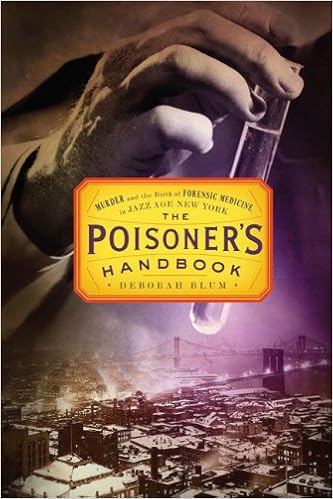
The Poisoner's Handbook: Murder and the Birth of Forensic Medicine in Jazz Age New York, by Deborah Blum

Free PDF The Poisoner's Handbook: Murder and the Birth of Forensic Medicine in Jazz Age New York, by Deborah Blum
Reading an e-book The Poisoner's Handbook: Murder And The Birth Of Forensic Medicine In Jazz Age New York, By Deborah Blum is sort of easy task to do every single time you want. Also reading whenever you desire, this activity will certainly not disrupt your other tasks; several people commonly read guides The Poisoner's Handbook: Murder And The Birth Of Forensic Medicine In Jazz Age New York, By Deborah Blum when they are having the extra time. Exactly what concerning you? Just what do you do when having the spare time? Do not you spend for worthless things? This is why you require to get the book The Poisoner's Handbook: Murder And The Birth Of Forensic Medicine In Jazz Age New York, By Deborah Blum and also aim to have reading habit. Reviewing this e-book The Poisoner's Handbook: Murder And The Birth Of Forensic Medicine In Jazz Age New York, By Deborah Blum will not make you worthless. It will certainly provide a lot more perks.
However, when a publication is popular, it will certainly go out rapidly. It is one of the matters that you need to think of. After strolling for much distances to obtain this book, it will not assure you to discover it. In some cases, you will certainly not find it in some shelfs. So, it will certainly be much better for you to obtain the book in this area. By only clicking the web link and also locate the book rapidly, you could wait and start to read. This is exactly what you could feel so happy to make far better for obtaining the certified source to review.
Also this book is made in soft documents forms; you can delight in analysis by getting the file in your laptop computer, computer tool, and gadget. Nowadays, analysis does not become a typical task to do by particular individuals. Lots of people from numerous locations are constantly starting to check out in the early morning and also every spare time. It verifies that people now have big interest as well as have big spirit to review. Furthermore, when The Poisoner's Handbook: Murder And The Birth Of Forensic Medicine In Jazz Age New York, By Deborah Blum is published, it ends up being a most desired publication to buy.
Just hook up to the net to obtain this book The Poisoner's Handbook: Murder And The Birth Of Forensic Medicine In Jazz Age New York, By Deborah Blum This is why we suggest you to utilize as well as make use of the developed technology. Reading book doesn't mean to bring the published The Poisoner's Handbook: Murder And The Birth Of Forensic Medicine In Jazz Age New York, By Deborah Blum Developed innovation has actually allowed you to check out only the soft data of the book The Poisoner's Handbook: Murder And The Birth Of Forensic Medicine In Jazz Age New York, By Deborah Blum It is very same. You might not should go as well as obtain conventionally in looking guide The Poisoner's Handbook: Murder And The Birth Of Forensic Medicine In Jazz Age New York, By Deborah Blum You may not have enough time to spend, may you? This is why we give you the best method to get guide The Poisoner's Handbook: Murder And The Birth Of Forensic Medicine In Jazz Age New York, By Deborah Blum currently!
Amazon.com Review
Amazon Exclusive: Author Deborah Blum's Top Ten Poisons On a recent radio show, I heard myself telling the host "And carbon monoxide is such a good poison.†We both started laughing--there’s just something about a Pulitzer-prize winning journalist waxing enthusiastic about something so lethal. But then he became curious--“Why?†he asked. “Why do you like it so much?†These days, as I travel the country talking about The Poisoner’s Handbook, I’m frequently asked that question or variations on it. What’s your favorite poison? What’s the perfect poison? The answer to the latter is that it doesn’t exist--except in the plots of crime novels. But in reality, poisons really are fascinatingly wicked chemical compounds and many of them have fascinating histories as well. Just between us, then, here’s a list of my personal favorites. 1. Carbon Monoxide (really)--It’s so beautifully simple (just two atoms--one of carbon, one of oxygen) and so amazingly efficient a killer. There’s a story I tell in the book about a murder syndicate trying to kill an amazingly resilient victim. They try everything from serving him poison alcohol to running over him with a car. But in the end, it’s carbon monoxide that does him in. 2. Arsenic--This used to be the murderer’s poison of poisons, so commonly used in the early 19th century that it was nicknamed “the inheritance powderâ€. It’s also the first poison that forensic scientists really figured out how to detect in a corpse. And it stays in the body for centuries, which is why we keep digging up historic figures like Napoleon or U.S. President Zachary Taylor to check their remains for poison. 3. Radium--I love the fact that this rare radioactive element used to be considered good for your health. It was mixed into medicines, face creams, health drinks in the 1920s. People thought of it like a tiny glowing sun that would give them its power. Boy, were they wrong. The two scientists in my book, Charles Norris and Alexander Gettler, proved in 1928 that the bones of people exposed to radium became radioactive--and stayed that way for years. 4. Nicotine--This was the first plant poison that scientists learned to detect in a human body. Just an incredible case in which a French aristocrat and her husband decided to kill her brother for money. They actually stewed up tobacco leaves in a barn to brew a nicotine potion. And their amateur chemical experiments inspired a very determined professional chemist to hunt them down. 5. Chloroform--Developed for surgical anesthesia in the 19th century, this rapidly became a favorite tool of home invasion robbers. If you read newspapers around the turn of the 20th century, they’re full of accounts of people who answered a knock on the door, only to be knocked out by a chloroform soaked rag. One woman woke up to find her hair shaved off--undoubtedly sold for the lucrative wig trade. 6. Mercury--In its pure state, mercury appears as a bright silver liquid, which scatters into shiny droplets when touched. No wonder it’s nicknamed quicksilver. People used to drink it as a medicine more than 100 years ago. No, they didn’t drop dead. Those silvery balls just slid right through them. Mercury is much more poisonous if it’s mixed with other chemicals and can be absorbed by the body directly. That’s why methylmercury in fish turns out to be so risky a contaminant. 7. Cyanide--One of the most famous of the homicidal poisons and--in my opinion--not a particularly good choice. Yes, it’s amazingly lethal--a teaspoon of the pure stuff can kill in a few minutes. But it’s a violent and obvious death. In early March, in fact, an Ohio doctor was convicted of murder for putting cyanide in his wife’s vitamin supplements. 8. Aconite--A heart-stoppingly deadly natural poison. It forms in ornamental plants that include the blue-flowering monkshood. The ancient Greeks called it “the queen of poisons†and considered it so evil that they believed that it derived from the saliva of Cerberus, the three-headed dog guarding the gates of hell. 9. Silver--Swallowing silver nitrate probably won’t kill you but if you do it long enough it will turn you blue. One of my favorite stories (involving a silver bullet) concerns the Famous Blue Man of Barnum and Bailey’s Circus who was analyzed by one of the heroes of my book, Alexander Gettler. 10. Thallium--Agatha Christie put this poison at the heart of one of her creepiest mysteries, The Pale Horse, and I looked at it terms of a murdered family in real life. An element discovered in the 19th century, it’s a perfect homicidal poison--tasteless and odorless--except for one obvious giveaway--the victim’s hair falls out as a result of the poisoning! Now that I’ve written this list, I realize I could probably name ten more. But I don’t want to scare you. --Deborah Blum
Read more
From Publishers Weekly
Starred Review. Pulitzer Prize–winning science journalist Blum (Ghost Hunters) makes chemistry come alive in her enthralling account of two forensic pioneers in early 20th-century New York. Blum follows the often unglamorous but monumentally important careers of Dr. Charles Norris, Manhattan's first trained chief medical examiner, and Alexander Gettler, its first toxicologist. Moving chronologically from Norris's appointment in 1918 through his death in 1936, Blum cleverly divides her narrative by poison, providing not only a puzzling case for each noxious substance but the ingenious methods devised by the medical examiner's office to detect them. Before the advent of forensic toxicology, which made it possible for the first time to identify poisons in corpses, Gettler learned the telltale signs of everything from cyanide (it leaves a corrosive trail in the digestive system) to the bright pink flush that signals carbon monoxide poisoning. In a particularly illuminating section, Blum examines the dangers of bootleg liquor (commonly known as wood, or methyl, alcohol) produced during Prohibition. With the pacing and rich characterization of a first-rate suspense novelist, Blum makes science accessible and fascinating. (Feb. 22) Copyright © Reed Business Information, a division of Reed Elsevier Inc. All rights reserved.
Read more
See all Editorial Reviews
Product details
Hardcover: 336 pages
Publisher: Penguin Press; First Edition edition (February 18, 2010)
Language: English
ISBN-10: 1594202435
ISBN-13: 978-1594202438
Product Dimensions:
6.5 x 2.1 x 9.3 inches
Shipping Weight: 1.2 pounds
Average Customer Review:
4.5 out of 5 stars
452 customer reviews
Amazon Best Sellers Rank:
#212,372 in Books (See Top 100 in Books)
I am a retired physician but I knew very little about the history and science that this book explores. This book is easy and very interesting to read. It is a layman’s guide to the politics, early science, and history of forensic medicine and a great tribute to those whose intelligence and hard work lead us to where we are today. The reader will enjoy the many human interest cases discussed that give the book a fascinating personal touch. This book is for those who like science, history and page turning nonfiction.
If you expect a dense scientific text or will be disappointed that some of the cases are accidental deaths and not murder, don't read. However, if like me you enjoy a bit of history, a bit of science, a lot of morbid investigation, and the triumphant underdog story of two luminary forensic examiners against the backdrop of Prohibition, the book is fascinating and morbidly fun.The title "Poisoner's Handbook" belies the book's true focus, the two amazing men at the center of each of the public histories of the poisons Blum writes about: chloroform, arsenic, cyanide, mercury, carbon monoxide, radium, ethyl and methyl alcohols, and thallium.Charles Norris, first Chief Medical Examiner of NYC, and his chief toxicologist, Alexander Gettler were, according to Blum, almost solely responsible for modernizing forensic science in the United States. Before Norris' appointment, the office of coroner required no medical training, and death certificates were often incomplete or falsified for bribes if they were filled out at all. Norris and Gettler spent their careers making forensics a rigorous study, and as if that weren't enough, were hugely influential crusaders for regulation of toxic substances, and for the repeal of Prohibition, which engendered a slew of deadly bootleg concoctions, including the industrial wood grain alcohol that the government endeavored to make more poisonous than it already was, knowing that it would be imbibed by prohibition breakers.Although the writing was snappy and fast-faced, Blum had little work to do to create drama; Norris and Gettler's heroic efforts to identify the effects of these poisons on the body in many cases for the very first time, and the huge failure that was the Prohibition largely did her work for her. I was riveted. I'm not sure why there isn't yet a forensic TV drama about the two men and the poisons they studied.
The Poisoner’s Handbook is a captivating blend of 1920’s crime stories and the chemistry that made it all possible.Blum’s book is easy to read (though it assumes an intelligent reader), the chemistry is never overwhelming, and the two gentlemen that she chose to follow throughout the chemical boom of the Roaring 20’s led fascinating jobs filled with mystery, murder, death, ground brains and Bunsen burners. And at under 300 pages, it is just the right length.I often use non-fiction books such as this to cleanse my palate (as it were) if I’ve had a bit too much fantasy and SciFi. This book did the trick.Also, reading the anecdotes in this book makes me want to quit my job and write murder mysteries because there are just so many sneaky ways of killing people! Fortunately, all y’all are safe - I very nearly failed junior Chemistry in high school, and sometimes, even measuring out teaspoons of coffee grounds in too much chemistry for me. I guess I’ll need to hire an evil genius assistant...
I absolutely loved this book. It is a highly readable account of the rise of forensic medicine and toxicology in the United States, focusing on the Bellevue lab in New York City. The book talks about a number of homicides (or, in some cases, accidents that were believed to be homicides) that resulted from poisonous chemicals. There are chapters on arsenic, cyanide, carbon monoxide, radium, thallium, etc. Some of the compounds that the author discusses were known to be poisons (like arsenic and cyanide, for example), whereas some were new compounds, discovered in the first third of the twentieth century, that were not discovered to be poisonous until ill effects were reported.The book is not just about crime or homicidal maniacs who use poison as their weapon of choice. It is also about changing technologies, corporate greed, and egregious misuse of chemical compounds that borders on being comical to the modern reader. (Radium health tonics. Blearghhh.)The book is well written (the crisp, non-academic writing is very refreshing - unlike the radium health tonics) and does not get overly bogged down in scientific terms. The author provides enough medical and scientific background to be relevant, but she presents it in layman's terms. I love reading about the periodic table, but since I am not a scientist, I find that sometimes I get lost when there is too much detail. That is not the case here. I highly recommend this book.
I thought this book read like a novel. I had bought it as a reference, and have used it as such, but read it from cover to cover. I've noted there are critiques that say some of the science is incorrect, so I suppose I'd check before I used a specific point in your own novel. I would not let the criticism deter you from buying it. The discussion of alcohol poisoning during Prohibition is enough reason to read this. I don't mention my own books in a review of others,' but in this case it's a compliment to Ms. Blum. Her Prohibition discussion helped me a lot as I wrote Rekindling Motives. Rekindling Motives (Jolie Gentil Cozy Mystery Series Book 2) I recommend this book for anyone who wants a broad overview of the topic.
The Poisoner's Handbook: Murder and the Birth of Forensic Medicine in Jazz Age New York, by Deborah Blum PDF
The Poisoner's Handbook: Murder and the Birth of Forensic Medicine in Jazz Age New York, by Deborah Blum EPub
The Poisoner's Handbook: Murder and the Birth of Forensic Medicine in Jazz Age New York, by Deborah Blum Doc
The Poisoner's Handbook: Murder and the Birth of Forensic Medicine in Jazz Age New York, by Deborah Blum iBooks
The Poisoner's Handbook: Murder and the Birth of Forensic Medicine in Jazz Age New York, by Deborah Blum rtf
The Poisoner's Handbook: Murder and the Birth of Forensic Medicine in Jazz Age New York, by Deborah Blum Mobipocket
The Poisoner's Handbook: Murder and the Birth of Forensic Medicine in Jazz Age New York, by Deborah Blum Kindle

Tidak ada komentar:
Posting Komentar